

Product-market fit for learning: AI disruption
A framework for thinking strategically about the opportunities and threats that AI is creating for teams building learning.

See original part 1: PMF dimensions and part 2: PMF stages.
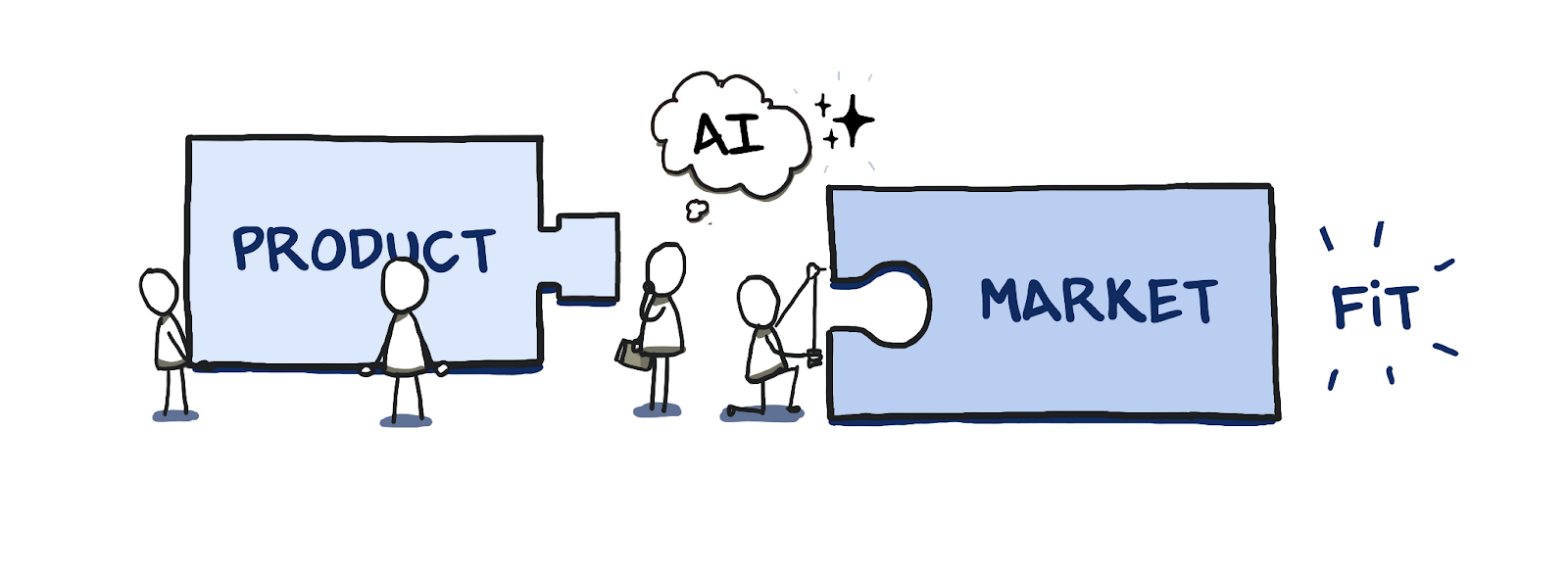
Many learning organisations are experiencing disruption to their product-market fit. If you haven’t felt it yet, you probably will soon.
The rules of product-market fit still apply. But over the last few years, AI has changed the game and the speed at which it is played.
Teams building transformative learning have always needed to understand:
What people need and aspire to learn.
How to deliver effective outcomes through experiences that are engaging and satisfying.
Where people discover their product and their perception of value and ability to pay to build a viable business.
What it is possible to deliver and how to do it at a meaningful scale.
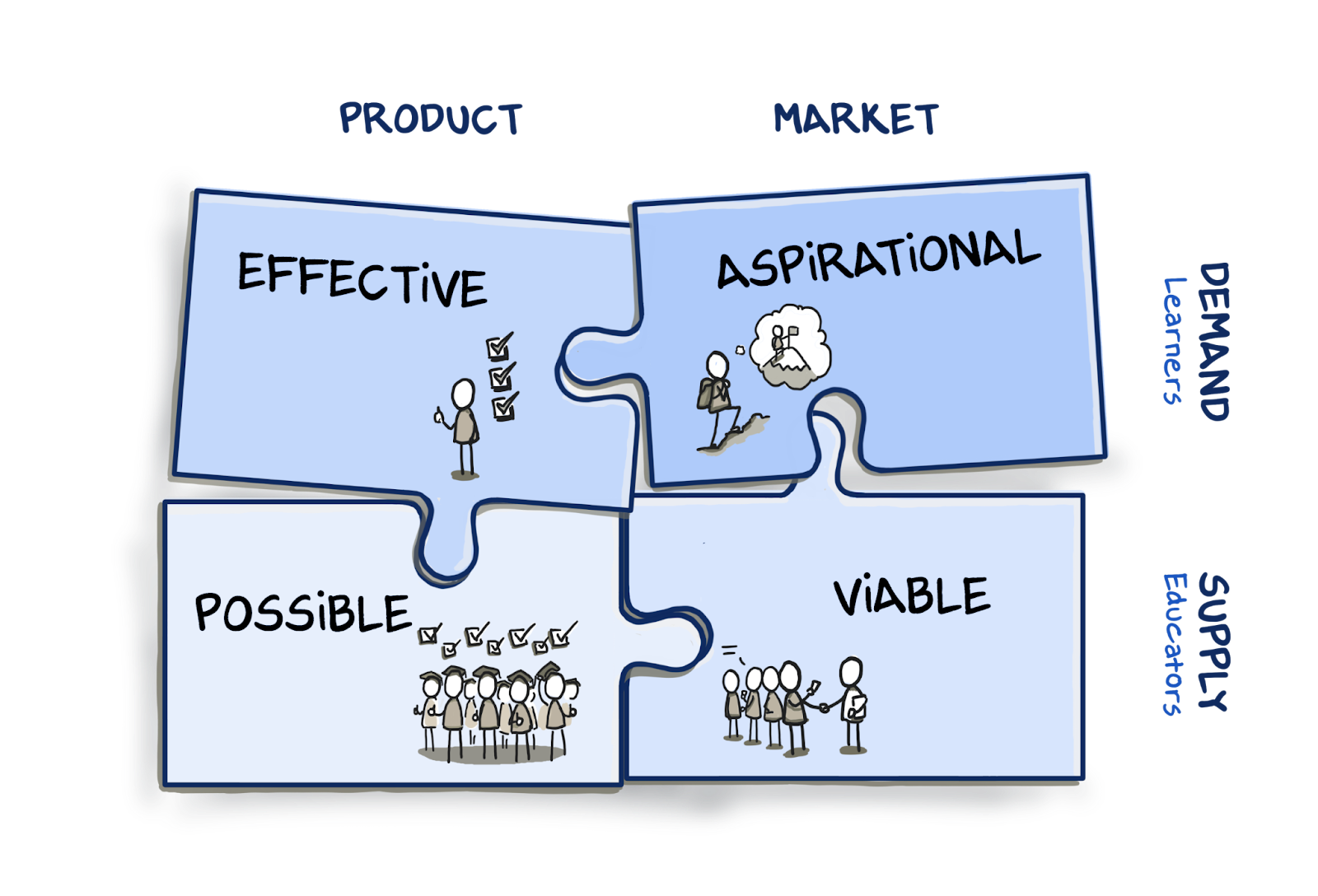
They have always needed to continue to adapt their value proposition as these things change. Product-market fit has never been static, it has always been something you need to continue to keep working at as the world changes around you.
But since the release of ChatGPT in November 2022, the world around us has been changing very quickly. We are seeing new leaps forward in capability every few weeks, from new models and modes of interaction to agents that can carry out complex tasks over significant periods of time. This is having dramatic impacts on all four of these product-market fit dimensions.
This means that organisations that have been successful, are suddenly feeling pressure and need to adapt.
By the end of this article, you will:
Have a tool to diagnose:
the threats to your existing product-market fit.
new opportunities to build product-market fit.
Understand the ingredients to a successful strategic response.
Gain insights through practical examples of learning organisations who have done it.
Let’s start by considering the case for change.
You will need to change
This doesn’t necessarily mean that you need to be immediately building AI products. One reasonable response could be to instead lean heavily into what humans offer that AI can’t. But you’re very likely to need to adapt what you do to the new context.
AI is likely to be able to do some aspect of the value you provide better, quicker and more cheaply than your current solution.
It may also be changing how people discover your product as the age of the search engine is replaced by the age of the answer engine.
It is likely to change your customers’ perception of value. Things that were rare and expensive, like content and knowledge, are now suddenly a commodity. And the things that AI can’t do, like human empathy and motivation, will suddenly seem more valuable.
It will probably change who you are competing with. The future landscape is likely to include a smaller number of dominant large organisations that can leverage data and network effects. But also, a long tail of smaller ones that can deliver more with fewer humans. These organisations will have deeper relationships and understanding of their users and their specific challenges.
ChatGPT, Claude and Gemini all have learning modes of some kind. Google is integrating Gemini into Google Classroom. The AI giants are very interested in learning. And their general technology is now the starting point for many who need to quickly understand how to do something new. For general, widely applicable things, these platforms will become the first port of call.
AI is also spawning a new wave of AI native companies that are using AI to find novel ways of delivering personalised and adaptive learning and tutoring. The starting point for these organisations is often quite different from those that have come before. The barrier to entry has never been lower with small teams able to build things very fast with the tools now on offer.
The speed of which you will need to change is also quickening. With the internet and smartphones, organisations had years to adapt. With AI, adoption is happening much faster, compressing the time you have to respond from years to months.
Overcoming The Innovator’s Dilemma
Pre-2023 learning organisations that have found product-market fit, are likely to be grappling with what Clayton Christensen called The Innovator’s Dilemma.
Successful companies are incentivised to continue to incrementally improve their existing products for their best customers. Meanwhile, new entrants are leveraging disruptive technologies - like AI - and creating new solutions, often at lower cost.
As we have seen with AI, in the beginning, they aren’t as good. They often start by serving an audience that hasn’t been able to access a solution before and are dismissed by the dominant brands. But, as we are also seeing with AI, they get better. They move up market. And because they can move faster than the incumbents, before they know it, the established names have lost their audience.
The famous examples of this are Kodak who prioritised their film business and did not adapt quickly enough as digital photography took off, Nokia and Blackberry whose dominance in mobile was rapidly undermined by smartphones, and Blockbuster whose video rental business was destroyed by Netflix’s streaming service.
But we are already seeing this happen in education, precipitated by AI.
The homework platform Chegg claimed 6.2m subscribers in 2022. 6 months after the release of ChatGPT their stock crashed by 50% after they acknowledged that AI was impacting growth. By 2025 their subscriber numbers had dropped to 3.2m.
ChatGPT was able to immediately provide personalised answers for free to the same questions that students needed a paid subscription to search for on Chegg.
In Chegg’s case, this disruption happened fast. Despite releasing CheggMate powered by GPT-4 within 6-months of ChatGPT’s emergence in May 2023, it was too late.
This cautionary tale is something that anyone who is focused on providing knowledge, including textbooks, on-demand courses and tutoring, should be paying attention to. And its impacts on learning and education will be far wider.
StackOverflow, until 2023, the go-to-platform for software engineers to ask questions, has seen a 78% drop in questions and is widely seen as dead. The self-paced learning giants Coursera and Udemy have merged, largely seen to be a response to the challenge of AI to create “an AI-powered skills acceleration platform for the global workforce”. And even Duolingo has had to aggressively embrace AI.
This dilemma is likely to apply to any organisation that existed pre-2023, from 3-year-old EdTech startups to 700-year-old universities alike.
And the challenge is the same as it always has been: can the incumbents innovate faster than the new entrants can find a market? Whether you are the established name or the new challenger, it’s all to play for.
Reflect: is your organisation grappling with the Innovators Dilemma? What are the activities that are hard to let go of that are likely to become obsolete? How might a new entrant deliver on your customers aspirations better and more cheaply in the age of AI?
Diagnosing the threats and the opportunities
Let’s diagnose the potential threats and spotting the new opportunities using the four dimensions of PMF. I’ll bring these to life with examples.

Dimension 1: Changing aspirations
The emergence of AI is having a dramatic impact on what people want and need to learn.
As the world of work changes, the capabilities that people of all ages need and want to develop are rapidly changing.
Skills that until very recently have been important and lead to potentially lucrative careers are suddenly less attractive. The tasks that make up white-colour roles in finance, law and tech are being fundamentally reshaped.
New in-demand skills and jobs are emerging and creating unmet needs. AI training is going mainstream. And some age-old human skills such as critical thinking, creativity, collaboration and adaptability are becoming even more important.
When and where learners want to learn is also changing. Upskilling on the job, just-in-time, is becoming more important. It’s also increasingly possible as new tools can coach you through how to apply new skills in the moment. Learners now automatically turn to AI and often use it as a tutor, not just for answers.
For educators, many are increasingly aware of the potential of AI to save them work but often unsure where to start. Being able to respond to the changing expectations and behaviour of their learners is also a big factor.
According to HEPI 92% of UK students used AI in some form, including 88% for assessments in 2025. Meanwhile, only 36% report receiving training in AI skills. This is a need universities and schools should be rapidly responding to and where partnerships with more nimble organisations could be effective.
For organisations, they are also looking for ways to support employees with the transformation. Some are looking for ways that AI can increase efficiency and reduce costs. This includes Learning and Development, where learning needs to move from expensive and episodic to cost-effective and continuous.
Case study
Makers are a UK coding bootcamp founded in 2013. They found product-market fit by helping career switchers find jobs as junior software engineers by training them in the skills required to do the job, in a way that prepared them for the workplace.
They successfully rode the bootcamp trend and the growing demand for this talent, so much so that they were able to offer job guarantees up until the pandemic. In 2017, they accelerated by spotting the UK Apprenticeship Levy early, which incentivised employers to spend money on developing new talent and became an accredited provider working closely with employers. To date, they have trained over 5,000 engineers and are one of the most respected in the sector.
The disruption
Today, demand for junior software engineers has collapsed, down by around a third from their 2022 peak. Junior software engineers are one of the first roles to be dramatically impacted by AI, with Anthropic’s CEO suggesting almost all of its code is now written by AI. This disruption is likely to play out across many other entry level roles.
The response
Whilst this was challenging for their core market, it was also creating a new opportunity. Makers have now successfully repositioned themselves from training software engineers to upskilling technical teams and the wider organisation in AI skills. They have leveraged their unfair advantage of being a certified apprenticeship provider to develop programmes that can be funded by the Skills Levy. They are applying their existing effective teaching approach to deliver the new AI programmes and existing deep relationships with technology teams as their route to market.
Read the full Makers case study.
Other examples:
Pearson is repositioning itself as a provider of AI learning services rather than a publisher and is focusing on AI study tools and pivoting to enterprise and upskilling.
Coursera launched Skills Tracks, data-backed learning mapped to specific occupations with verified skill assessments, not just completion certificates.
Reforge has added five new AI product building tools on top of its education business, enabling learning and doing simultaneously.
The London Interdisciplinary School has introduced a Masters in AI and Collective Intelligence.
Reflect: How is AI impacting the needs of your audience? What is no longer needed or a pain point? What unmet needs are starting to emerge that you are well placed to address?

Dimension 2: Evolving expectations (Effective)
AI also evolves the expectations of learners and teachers. The big shift is from static answers to dynamic outcomes. Once people use AI, it changes their expectation of all other products.
Instead of needing to work through monolithic, one-size-fits all courses or searching for generic answers, learners increasingly expect just-in-time, in-context learning, personalised to them that adapts to what they already know.
There is a growing low tolerance for searching through libraries, waiting for tutors and completing static exercises.
Meanwhile, there is increasing value in contact with humans, verified credentials and outcomes AI cannot easily generate. If you own the process of learning, not just the content, this is likely to mean you are at less risk of being disrupted.
More generally, if your experience is something that is engaged with regularly, you are less at risk than something that people don’t use often. If they are not in a habit, it is easier for them to choose a new way to solve the problem.
Educators can also see the opportunities to create materials tailored to their learners extremely quickly and the potential to save hours on planning, marking and other administration and instead focus on teaching.
But they worry about academic integrity, the accuracy of machine marking, and how to ensure their students engage in the ‘struggle’ that is so important to effective learning.
Case study
Oak National Academy began life during the COVID-19 pandemic as an emergency response to provide teachers with the resources they needed to teach classes online. They have a catalogue of video lessons and materials such as quizzes covering the whole of the UK national curriculum, from age 4-18. In September 2022, they became an arms-length government body with a remit to improve pupil outcomes by supporting teachers and providing access to a high-quality curriculum.
The disruption
As they began to shift their emphasis from delivering online lessons to students, towards supporting teachers, ChatGPT was released.
They observed that tech savvy teachers were experimenting with AI as a way of helping them plan lessons and create materials. This was enabling them to create content personalised to the needs of their classes.
In 2023, Oak received an additional £2m to build free-to-access AI tools to support teachers.
The response
They quickly began to experiment with the opportunities that AI offered to support their Theory of Change. Their goal was to offer something that was higher quality and safer than the out-of-the-box tools, and that kept the teacher in the driving seat.
They created a team to specifically focus on building new tools and supported them with additional training such as machine learning apprenticeships.
They anchored the AI generated lesson plans with their corpus of UK National Curriculum content (350,000 mins transcribed video) and codified their deep expertise in lesson planning into a prompt to guide responses. They also made use of their community of teachers to help evaluate and benchmark the tool and ensure its accuracy and safety.
They released Aida, their lesson planning assistant, which enables teachers to plan lessons that would have taken them an hour in ten minutes, saving teachers 3-4 hours per week. Lesson plans come complete with slides, quizzes and support materials and teachers can tailor them with local references and the appropriate reading age.
Read the full case study.
Other examples:
Sana Labs have pivoted from offering a personalised learning platform for corporate Learning and Development to a personalised learning assistant that provides support in-the-moment.
Coursera have launched Course Builder, reducing the time to create a course by 80% and Academic Integrity Platform offering online proctoring.
Perlego, the virtual research library, have launched Dialogo, a tool designed as a research accelerator not an answer provider.
Reflect: How is AI changing the expectations of your audience? How can you deliver on outcomes for them more effectively than before? What is likely to feel less valuable, useful, satisfying and engaging than it did?
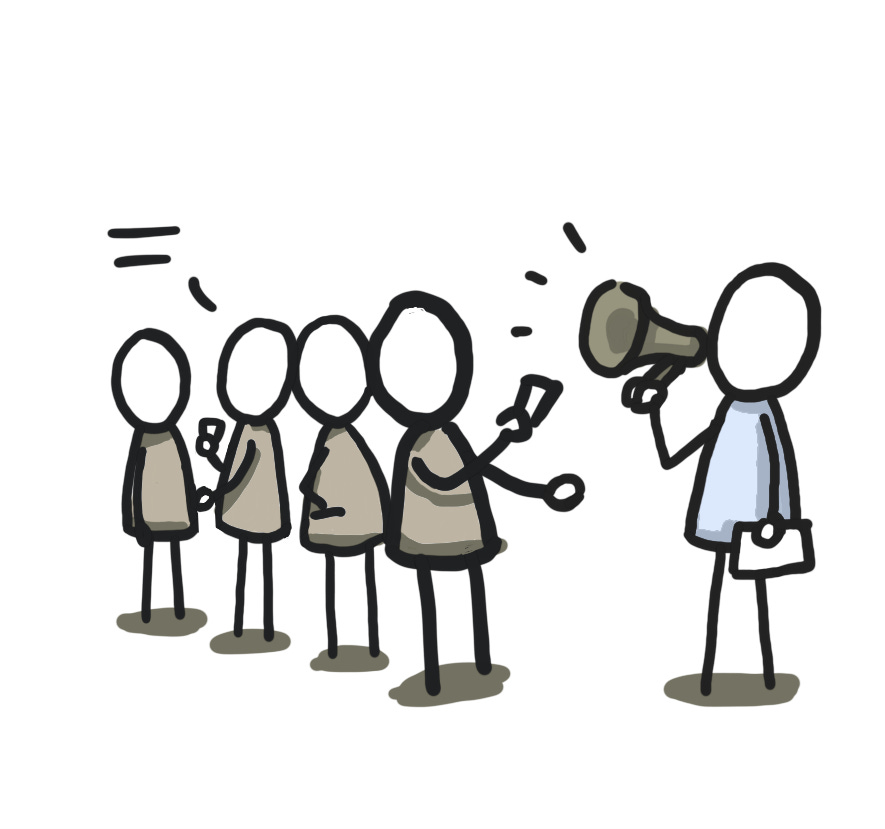
Dimension 3: Disrupted discovery and perceptions of value (Viable)
AI is disrupting the way in which products are found and valued.
Instead of searching for solutions, people are being delivered suggestions in AI generated answers, with dramatically lower click through rates.
Traditional paid advertising is feeling the squeeze and social networks are increasingly walled gardens but alternative routes-to-market are still emerging. AI is also powering a vast increase in the amount of content being created, making it harder than ever to be visible.
The shift is from competing for attention, through performance marketing and Search Engine Optimisation to earning visibility by being a valuable part of an ecosystem.
Word-of-mouth and products that harness virality and network effects are still successful. Many forward thinking organisations are now leaning into building community and finding ways of providing mutual value exchange to support discovery. Khan Academy now embeds Khanmigo in Microsoft’s Education Suite, which makes it free for teachers and gives them free infrastructure as well as distribution.
The cost of providing products is also changing the game. The internet disrupted by enabling the delivery of the same product to vast numbers of people for the same cost as to an individual.
This is not true of AI due to the computational cost, billed as credits. Whilst the cost of credits is going down, the number of credits needed for increasingly sophisticated applications, is going up. The increasing expectations means that users want the most expensive models. This creates a different dynamic for growth models that rely on freemium access: free users cost money.
There are some indications of what some of the new discovery channels might be, often reinventions of familiar paradigms.
ChatGPT has launched Apps that are suggested based on the user’s conversation (not yet available in Europe). Coursera was one of their launch partners and whilst the experience is currently a little underwhelming, it hints at a potential future.
There has recently been speculation around how advertising will come to ChatGPT, with low-cost and ad-funded vs high-cost and privacy-conscious likely to become a similar dividing line between OpenAI and Anthropic as it has between Android and Apple.
Meanwhile, perceptions of value are also rapidly changing. Content and knowledge, once rare and highly valuable is now abundant and commoditised, dramatically reducing the expectation of how much it costs. On the other hand, human, authentic, live experiences are feeling increasingly valuable.
Ultimately, if you can own the relationship with the user and generate word-of-mouth, you are at less risk that if you rely on search or channels that are being disrupted themselves.
Case study
Novakid is the biggest language teaching platform for kids in Europe. Their human tutors deliver over 5 million live online lessons a year to over 80,000 students. They have amazing reviews, the kids love their teachers.
The disruption
A typical 6-month course package costs $500 on Novakid. Over the last couple of years they have seen a range of new entrants offer AI coaching for as little as £34.99 for 6-months. They are confident that human teaching is still better. But is it over £400 better in the eyes of their customers? They are also acutely aware that the current solutions are only going to get better.
The response
Recognising this risk, they have begun to experiment within their existing experience, introducing AI practice alongside human teachers, who continue to provide the human connection and motivation.
Whilst AI is likely to become better at helping teach the mechanics of language, ultimately, their primary Job To Be Done is for kids to be able to socialise with other humans. They are emphasising these benefits as part of the value proposition.
They have also explored how they would change their pricing structure from pay-per-lesson to something that might include a mixture of language learning benefits that will enable them to find the optimum package, based on the evolving perceptions of value.
Read the full case study.
Other examples:
Coursera has launched a ChatGPT app, that surfaces content within ChatGPT.
Khan Academy has moved from a paid model for Khanmigo to embedding it in Microsoft’s enterprise education suite where Microsoft donates the infrastructure and provides distribution.
Grammarly has pivoted from a direct-to-consumer grammar checker browser extension found in the Chrome store to an enterprise AI powered writing platform, acquiring Superhuman email and Coda collaborative docs.
Reflect: How do people currently discover your product? Are the channels they find you through being disrupted? How can you develop greater word-of-mouth and become part of ecosystems to remove this risk? How are the costs of delivery and perceptions of value changing? What does this mean for your business model?
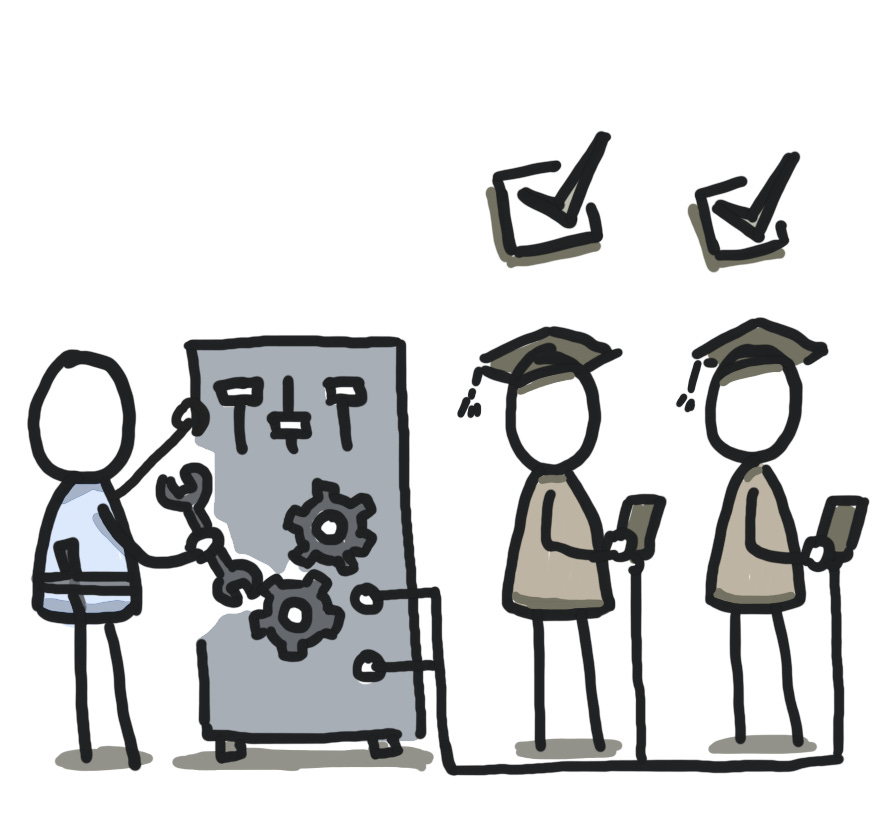
Dimension #4: Emerging possibilities (Possible)
Finally, what it is possible to deliver - and at scale - is rapidly changing. New possibilities are emerging.
The challenge with learning and education is that it often requires humans to motivate learners by understanding what they need and then personalising the learning to them. AI is changing the equation.
What in the past might have required significant numbers of humans to deliver - be that one-to-one tutoring, learning material creation, student support, student recruitment, or writing the code to make interactive learning apps - can all now be done with fewer people. This frees them up from repetitive tasks to focus on higher value work.
It opens up the possibilities for educational experiences that were previously unthinkable, tailored to specific use cases of individuals and organisations.
Organisations need to reorganise and upskill to take advantage of the opportunities and mitigate the threats. Smaller, more empowered teams are likely to be capable of delivering more.
Meanwhile, we now have tools (Lovable, Replit, Figma Make, v0…) that make it possible for smaller, nimbler teams to quickly prototype and conduct product discovery in a way that until very recently would have needed more time and people.
In a rapidly changing world, continuous innovation is increasingly necessary. Being skilled at this discovery work - building the right thing, not just building the thing right - is likely to become the differentiating factor as delivery becomes less of a bottleneck.
For organisations who provide value through content libraries that are under threat of disruption, there is the potential to turn these assets to their advantage by using them as the unique data that powers more personalised learning experiences.
Case Study
IU International University of Applied Sciences is Germany’s largest university with over 130,000 students studying across 200+ degree programmes. Since 2000, they’ve specialised in flexible online learning, enabling students to balance studies with work and family commitments across different time zones and locations.
The challenge
With over 130,000 distance learning students spread across multiple time zones, providing personalised, 24/7 tutoring support was economically unviable. Students had to wait for tutor responses and often received one-size-fits-all materials that didn’t account for their existing knowledge or learning pace. Research has long shown that personal tutoring is transformative but at scale, this simply wasn’t possible.
The opportunity
In 2022, before ChatGPT launched, IU began developing Syntea, a machine learning-powered learning companion trained specifically on their course materials. They leveraged LLMs once they were released.
Students can ask questions and receive immediate, course-specific answers, verified by human tutors to ensure quality and accuracy. The tool assesses students’ existing knowledge before they start a course, and creates personalised study plans that skip what they already know, and adapt to their learning pace.
For tutors, it dramatically reduces the workload of answering hundreds of repetitive questions and enables them to focus on complex queries and improving answers.
IU believes that students using the Syntea regularly complete their studies 27% faster and the Net Promoter Score of 74% reflects high satisfaction.
Other examples:
Degreed have launched Maestro that enables learners to practice having difficult conversations - something that previously would have been hard to do at scale.
Babbel have launched Babbel Speak, a voice-led conversation trainer, something impossible without humans until recently.
Khan Academy have introduced Khanmigo, pivoting from on demand video lessons to socratic coaching, that leverages their catalogue.
Reflect: What is possible now that wasn’t but a few months ago? What does this mean for the cost of delivery? What unique assets do you have to leverage? Are you ready to compete through being good at product discovery?
The shift at a glance
Here is a summary of the shifts we are seeing across each dimension.
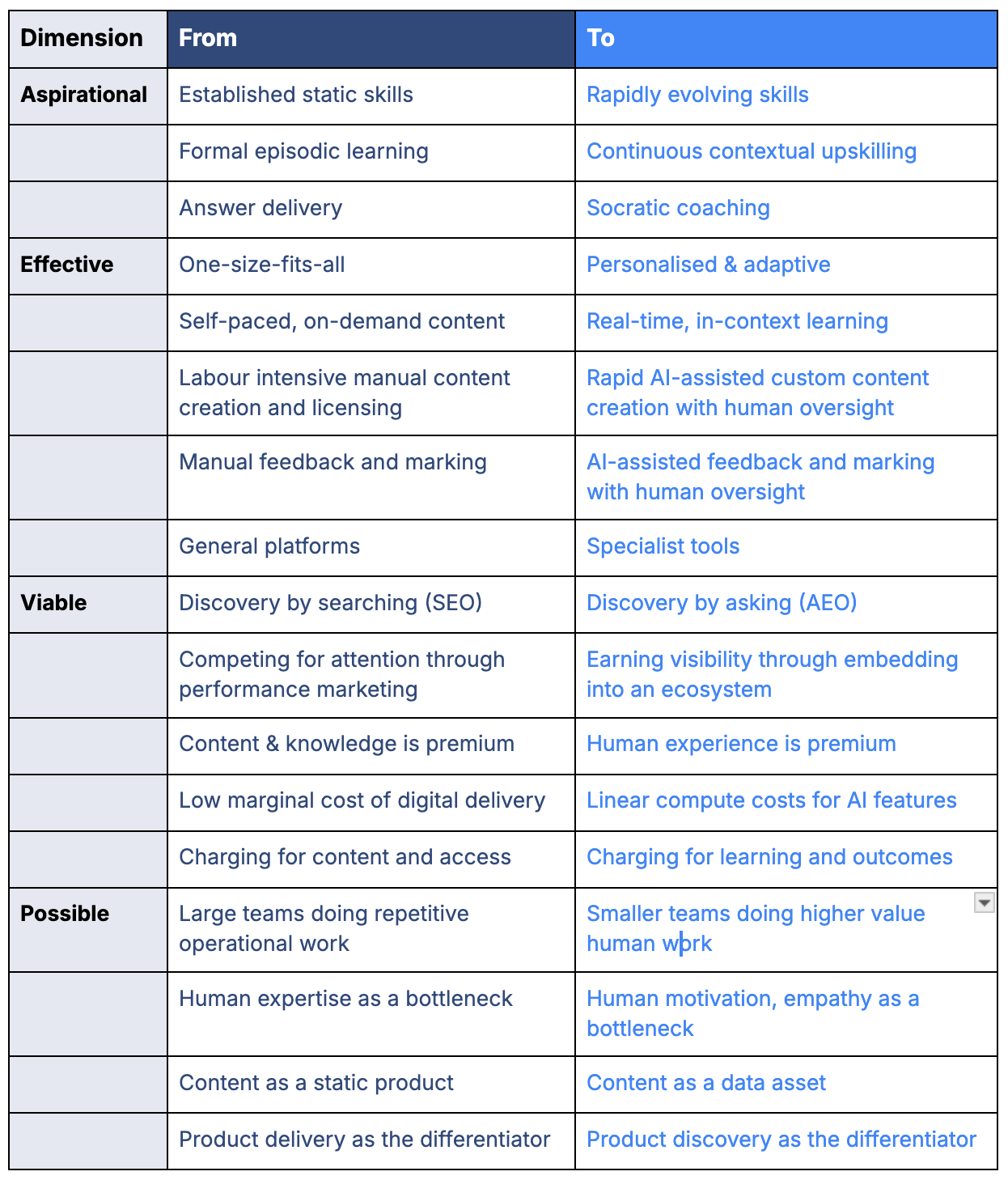
Reflect: as you review this summary. Which are the shifts that most resonate with you about the strategic change that you need to make?
Themes in successful strategic responses
These stories highlight eight general themes about how to respond successfully. Reflecting on each of these can help you develop a successful strategy.
Changing aspirations
Focus on the Jobs To Be Done
In almost all situations, those successfully embracing disruption went back to the core problem they set out to solve, rather than the capabilities of the technology. It was about returning to their vision and purpose and focusing clearly on the Jobs To Be Done: either by thinking about new ways to solve it, or updating it based on the changing needs of their audience.
Makers: authentic training for in-demand tech skills.
Oak: giving teachers back their Sunday night.
Novakid: enabling kids to communicate with other kids in English.
IU: supporting students to deeply understand complex subjects.
Reflect: what are your audiences’ Jobs To Be Done?
Reposition with a clear value proposition
Once they had identified their new strategy, often it meant significantly repositioning the value proposition. Generally, this also meant being really clear about addressing specific pain points vs providing a general platform. This might also mean targeting people who don’t currently use your product.
Makers: from creating junior software engineers to upskilling in AI skills.
Oak: from on-demand lessons for students to empowering teachers through intelligent digital tools.
Novakid: from pay-per-lesson to a learning and practice subscription.
IU: from access to human tutors to 24/7 support, quality assured by experts.
Reflect: what are you repositioning from… to… ?
Evolving expectations
Reimagine, don’t bolt on
The most promising examples have been about reimagining the solution from the ground up, rather than bolting on an AI powered gimmick. This is treating AI as infrastructure, rather than as a feature. The question that unlocks this is often what could be 10 times better, rather than a 10% improvement?
Makers: new AI apprenticeships and training programmes.
Oak: a lesson planning assistant built on top of their curriculum.
Novakid: a holistic learning package including human tutors and AI practice.
IU: entirely new approach to tutoring that provides always-on support.
Reflect: what is the 10x bet vs the 10% feature?
Build trust by keeping humans in the loop
The best responses are about thoughtfully understanding the value of what AI enables and what humans can uniquely do - and often finding the right blend. Keeping humans in the loop is generally crucial to creating the motivation, empathy and the trust required to deliver great learning.
Makers: applied their existing pedagogy of project based learning and pair programming supported by experts.
Oak: keep the teacher in the loop every step of the lesson planning process and ensure that they are thinking through the lesson they will deliver.
Novakid: complement human tutoring and conversation with other kids with AI practice and identification of misunderstandings.
IU: continue to use tutors to create and verify automated answers to repetitive questions and use their time for the more complex and interesting questions.
Reflect: what is AI better at and what do humans still excel at? How could AI free up humans from repetitive tasks to provide greater value to learners?
Disrupted discovery and perceptions of value
Be part of an ecosystem
Becoming a valuable part of an ecosystem that enables discovery is likely to be more resilient than relying on search and social networks that are increasingly disrupted and where it’s increasingly hard to gain attention. This could be developing business-to-business partnerships, rather than going direct-to-consumers and continuing to keep looking out for the emergence of new discovery channels like the AI platforms.
Makers: utilised their existing relationships with enterprise partners.
Oak: have created a Google Classroom plugin version of their lesson planner.
Khan Academy: is bundling Khanmigo with the Microsoft Education Suite.
Coursera: has created a ChatGPT app.
Reflect: What emerging or non-disrupted ecosystems could you be part of to remove your reliance on search and social?
Charge for outcomes not outputs
As the expectations move from content and answers towards an emphasis on the learning and the outcomes, shifting the business model to reflect this is likely to be necessary.
Makers: focus on the outcomes of learners getting jobs and validating new skills through their apprenticeships.
Oak: are funded based on their Theory of Change which measures the impact they have on problems like teacher workload.
Novakid: is moving from pay-per-lesson to a wider set of learning benefits.
IU: have moved from a limited number of tutor interactions to shortening the time that it takes for students to complete degrees.
Reflect: are you currently charging for outputs like content and access? Is this likely to come under pressure? What are the outcomes you produce that better align with the value your users get?
Emerging possibilities
Leverage your ‘unfair advantage’
In all of the examples, the organisations recognised where they had an unfair advantage to leverage. This could be existing content, expertise or awarding powers that provides a moat that new entrants will struggle to replicate.
Makers: as an accredited apprenticeship provider were able to offer AI programmes that were eligible for the UK Growth and Skills levy.
Oak: built their lesson planner on their huge corpus of UK National Curriculum content and codified their expertise in lesson planning.
Novakid: used their codified expertise in teaching languages to create their practice tool and their large existing audience to test it.
IU: redeployed their expert tutors to provide highly accurate and quality assured answers.
Reflect: what unfair advantage could you leverage? Content, expertise, accreditations?
Experiment and co-create
Those that have successfully responded to the challenge have reorganised to focus on product discovery. They have rapidly experimented and co-created with their audiences. This has enabled them to rapidly learn and refine solutions.
Makers: initially launched one day AI training courses with their existing partners.
Oak: set up a separate team and a ‘labs’ section of their website to explore a range of opportunities and worked with their extensive community of teachers to test and validate them.
Novakid: injected rapid Minimum Viable Tests into the existing user journey to get rapid quantitative feedback on how well experiences retained learners.
IU: experimented with NLP models to address tutoring challenges from 2019. After LLMs provided the unlock in 2022, they iteratively rolled out Q&A, then pre-assessment profiling, then the exam trainer to a small number of courses (~40) before rolling out to the full portfolio (1,100+).
Reflect: what small experiments could you start delivering immediately to get the feedback on real users? How might you involve them in the process? How might you reorganise to enable this focus on product discovery?
Stages of PMF
Product-market fit is not a specific moment in time and instead a continuous process.
However, I have previously suggested that there are a number of common stages that products work through, which enables teams to focus on what is most important and avoid becoming overwhelmed.
The disruption that AI is creating means that one or more of the four dimensions is coming under pressure. Depending on which dimensions will affect how you might think about your stage and focus.
Identifying which dimensions are most under threat and presents the most opportunity can help provide this focus.
You’re quite likely to need to return to the beginning and reassess why people might aspire to your product. With luck, some of your existing expertise in delivery and channels for discovery will provide you with unique advantages to address them in an effective and viable way. But it’s quite likely that you’ll need to reassess these too.
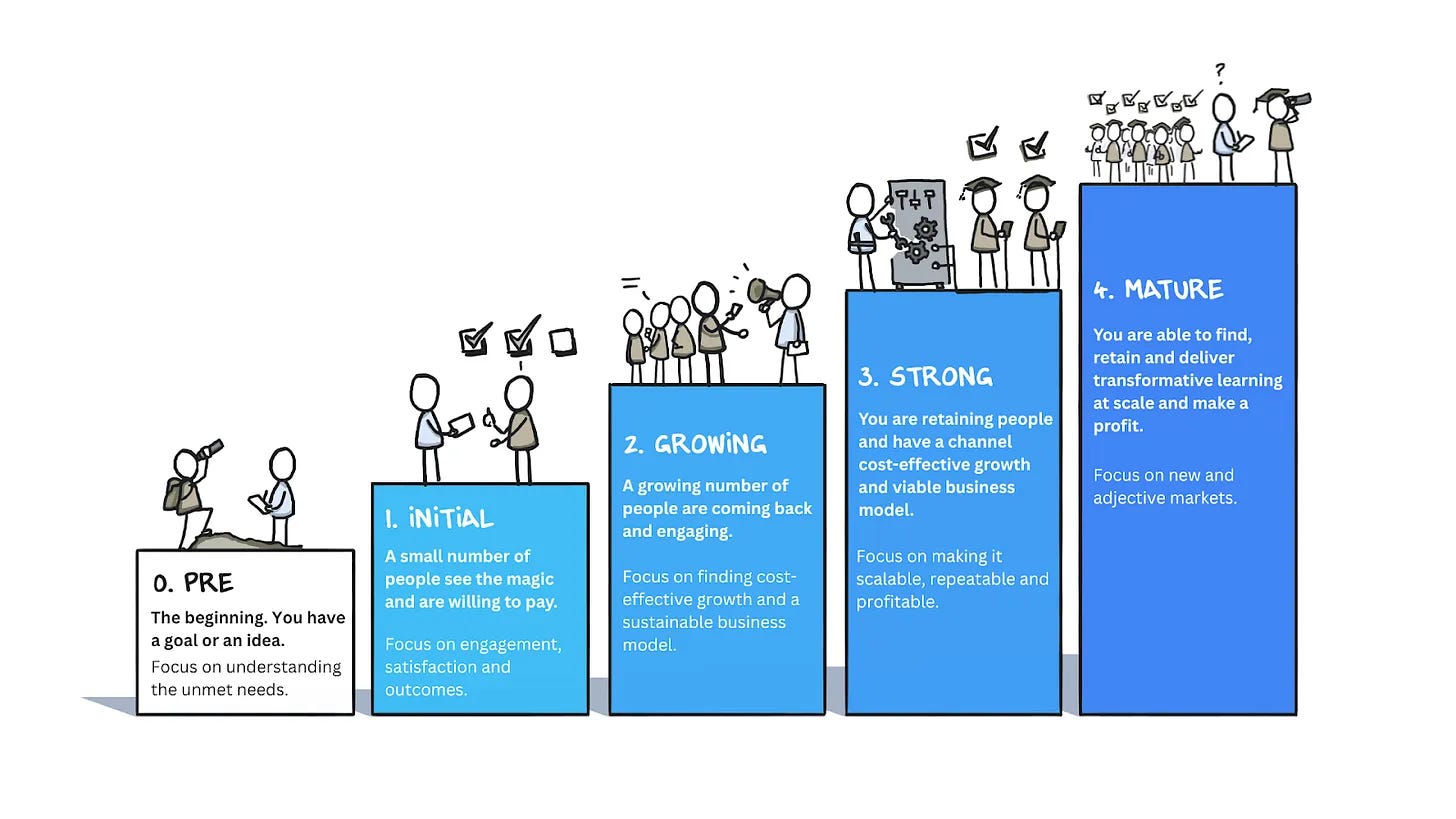
For Makers, they needed to go back to step 0 and focus on what people needed and aspired to learn. But their existing approach and route to market still proved to be effective making it easier to work their way through the next steps.
For Oak, they also focused on a new need, and leveraged their existing assets to be able to create a new effective solution. By rolling out the new product to their existing audience, over a third of UK teachers are now using the product. They are exploring new distribution methods through partnerships with the likes of Google Classroom.
For Novakid, they continued to focus on the same needs and what they had already found to be effective and complement it. The challenge came around revisiting their business model and what it is now possible for them - and new entrants - to deliver. Stage 2.
For IU, the key challenge was around scale and serving their vast student body. AI has enabled them to deliver more effective results at scale. Stage 3.
The emergence of AI, makes the already messy process of creating new products even less linear than before. It is quite likely that you will need to go back to earlier stages in order to reinvent what you do.
Reflect: which stage does the emergence of AI mean that you need to revisit?
Transformation, innovation and the product model
The current disruption is as big, potentially bigger, than the arrival of the internet or smartphones. It requires existing approaches - and institutions - to be rethought. And it is potentially happening even faster than the adoption of previous technology.
This means that all organisations, big and small, need to transform how they work to be able to continuously adapt to changing new realities.
The old project-based model of waterfall delivery and incremental change is going to come under more pressure as more youthful and nimble organisations are able to more effectively deliver with fewer resources. Embracing new ways of working is becoming existential.
In the Innovator’s Dilemma, Clayton Christensen suggested two important factors in successfully embracing disruptive innovation.
Firstly, to create a separate unit with its own economics, matched to the size of the current market opportunity and give it autonomy. For new opportunities to look exciting and not be rejected by the parent organisation, it needs to be set up as a separate team, potentially with its own P&L and then be protected by senior leadership.
Secondly, to focus on ‘emergent strategy’ and learn by doing, rather than ‘deliberate strategy’, which is top down. You need to get real market feedback and iterate, rather than having a predetermined plan. Once you know what works, only then can you scale it.
The product model, which emphasises empowering small teams, focusing on needs, product discovery, rapid experimentation and iteration and the adoption of new technologies to find successful new models is more needed than ever: including in organisations that haven’t yet adopted it.
Fortunately, despite the fact the game is changing increasingly quickly, many of the tried and tested concepts and methods we’ve explored in part 1 and part 2 still apply.
This article provides the framework to think about the challenges in a structured way and offers principles to consider your response.
If you would like help facilitating this conversation with your team and support to build your capabilities around product discovery and developing new products, get in touch. I can help with workshops, custom programmes, coaching and even (for the right project) hands-on fraction work.
Good luck. And remember, you will need to change.
Great post Matt! Extremely thought provoking and timely.