

The Raspberry Pi Foundation’s responsible tech for kids
How The Raspberry Pi Foundation is taking a principled approach to building products that prioritises learning and wellbeing.

“For anyone involved in making technology for schools, we are at a moment where the very existence of our organisations is about to be questioned,” says Laura Kirsop, reflecting on the growing backlash against edtech.
Laura is Director of Product at The Raspberry Pi Foundation, currently interim Chief Product and Technology Officer. She joined our recent Product For Learning meetup for a fireside chat.
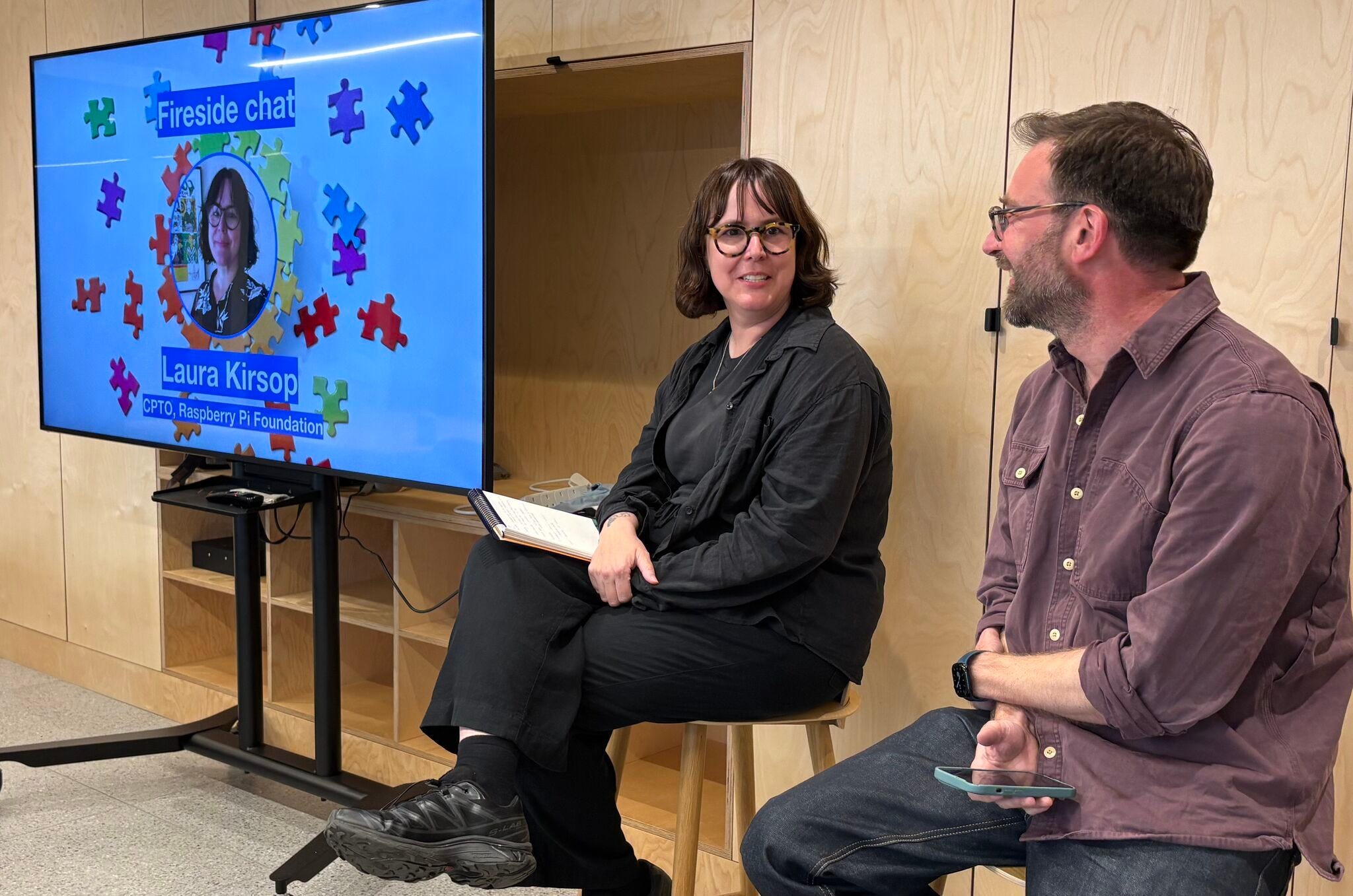
Our conversation, exploring building responsible tech for children and the need to take a principled approach that prioritises learning and wellbeing not just engagement, already felt urgent. Since then, the UK has announced a social media ban for under 16s, based on the one introduced in Australia last December.
Using social media for leisure and education technology for learning are very different things. But the same energy and debate that created a successful movement to restrict social media is now expanding the argument to edtech.
“The main proponents in that debate and the one to ban phones from schools, are now moving their sights onto edtech,” observes Laura. “Jonathan Haidt, who wrote The Anxious Generation, is on LinkedIn now saying get computers out of elementary schools.”
The neuroscientist and educational consultant Jared Cooney Horvath’s book The Digital Delusion, released last December is also driving heated debate in the US. It starts “Our children are less cognitively capable than we were at their age” and links this to the rise of edtech. He argues that once parents realise they can successfully push back against phone usage, they naturally extend that same skepticism to classroom tools like Chromebooks and tablets.
Laura, herself a mum and who recently completed a Masters in the Sociology of Education at UCL and was awarded a distinction for a dissertation on this very topic, has a lot of sympathy for why we have arrived at this point.
“The research does suggest that not all education technology products have a positive impact on learning,” she reflects. “So the onus is on all of us to examine what we’re doing. Can we genuinely say that the products we’re making for kids are net beneficial to their lives? And can we prove that?”
Taking a principled approach
To begin to address this, The Raspberry Pi Foundation, which now operates separately from the microcomputer company as an independent, technology-agnostic non-profit, funded with an endowment from Raspberry Pi’s IPO, is introducing a set of principles that will guide how they design and build their products.
Laura is leading this work, which brings together their reflections on their own best practice with the insights from leading thinkers and organisations such as UNICEF (see references below). She is keen to collaborate with others in the space and coordinate a coherent response, grounded in evidence.
“I’m nervous that the rug will be pulled out from under us completely and there will be no nuance left in the discussion,” she worries. “If laptops are completely banned in schools, what do we do then?”
These concerns are well founded. Spain is already restricting individual devices in primary schools in some regions, and other European countries are exploring similar legislation. Meanwhile, California, home of Silicon Valley, leads the pack of more than a dozen US states considering bills that restrict the use of technology in classrooms. Mainstream publications like The Economist have also published articles with headlines such as “Ed tech is profitable. It is also mostly useless.”
Much of this sentiment is pro-learning and not necessarily anti-tech. But, as with big tech’s failure to address the very real concerns around social media leading to public opinion quickly shifting and resulting in blanket bans in Australia and (soon) in the UK, it is possible that without visible, proactive action that puts learning and wellbeing before engagement and profit, a similar blanket approach could be applied to education technology.
So what does a proactive and principled approach look like in practice?
Treat kids as creators, not consumers
“I really believe that not all screen time is equal,” says Laura. “If you’re doing something creative, like programming a game, or something where you’re exercising your agency or creativity, that is very different from doom scrolling. So how do we help young people experience the power of creating technology rather than just consuming it?”
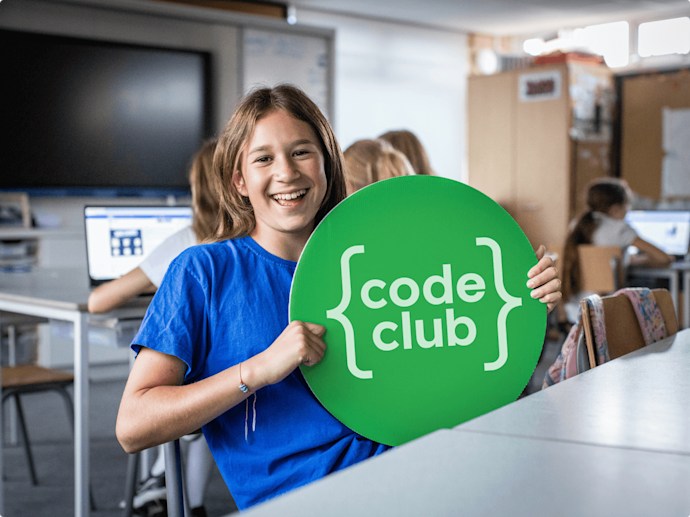
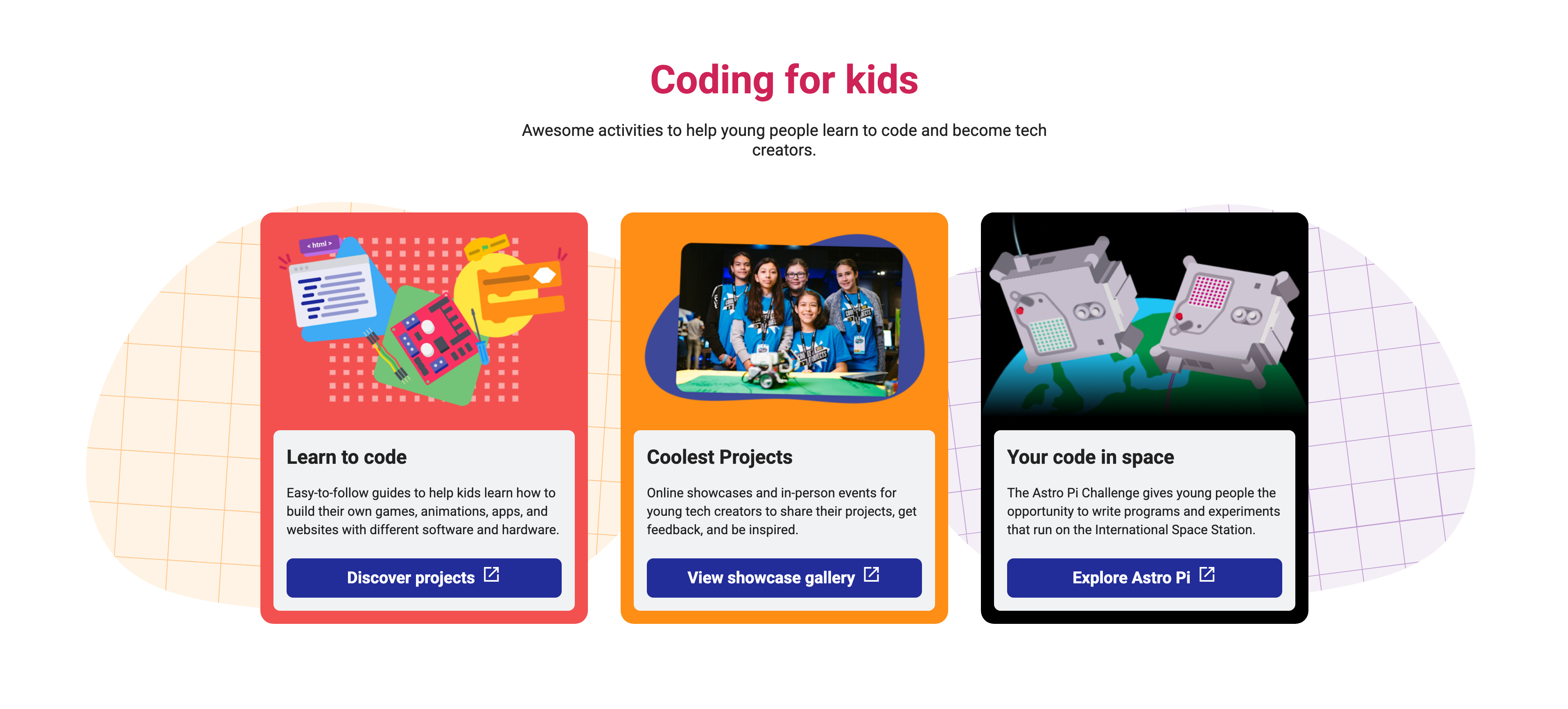
This is central to The Raspberry Pi Foundation’s approach. It runs Code Club, the largest global network of after-school coding clubs, supported by online tools. “We’re reaching millions of educators and young people every year,” says Laura with evident pride (she was one of the original team before Code Club became part of RPF).
The foundation also runs Coolest Projects, an annual technology showcase celebrating creations from young people all around the world, and The European Astro Pi Challenge that gets young learners to write code that runs on the International Space Station. They have created a classroom-friendly code editor, and you can read my case study here.
Laura believes prioritising agency and enabling creativity is a principle that should be a key part of any technology product aimed at kids.
Design with children, not for them
This thread of creativity should also extend to how products are designed and built.
“One theme that runs through all of that literature is children’s voices being involved in any design or any decisions you’re making,” says Laura. “When you’re making things for kids it’s really important that we’re co-designing with them, listening to their needs and allowing them to be part of the design process.”
This was a big part of how they approached Code Club World, their online response to Covid-19’s closing of their in-school Code Clubs. They built a community of kids and parents that they co-created with throughout the process.
“We had conversations with parents and children in the diary every week, and the designers and engineers on those calls. It felt like we were collaborating with those users rather than it being a piecemeal approach,” she explains.
“The main thing I took away from it was that I had so many assumptions that were completely wrong,” she remembers. “My instinct going in was we absolutely can’t do any social interaction online. But a lot of the kids and parents were actually really comfortable with it.”
This finding supported one of their other principles: support human relationships, not replace them. “The kids were coming up with ideas like, we could do pair programming with each other, and that would really help us complete these projects.”
Their learners also took an active role in the design: “We got the kids involved in picking the characters and designing the islands that featured in the product.”
During another recent project, they took a product problem they had to a workshop of 15-17 year olds to solve. “They came up with a range of solutions a lot more weird and interesting than what we would have ever considered,” says Laura. “Our original solution was nowhere near as creative as some of the things the kids came up with. It really helps challenge your thinking.”
She encourages everyone working on technology for children to build co-creation into the process and ensure a diverse range of needs and perspectives are represented.
Measure impact not engagement
The big problem with many edtech products is the relentless focus on engagement. Whilst creating an engaging experience is fundamental to learning, many products focus on maximising use and consumption over learning outcomes, which are often much more complex to measure.
“It’s inevitable. Many organisations have a commercial incentive to capture as much of the school market as they can, and the easiest thing to demonstrate is use,” says Laura.
She also cites the orthodoxies around building products that need to be adapted for edtech. “You have to unlearn a lot of product thinking where the assumption is often big is better. When I first started [at The Raspberry Pi Foundation] I’d take conversion metrics to our CEO and he’d often challenge me and say, ‘But have children actually learned something?’”
This has made her think hard about what the appropriate success metrics are.
“Kids using our product are actually making stuff: a computer program or a game. So one of the things we’re experimenting with is taking samples of the work they’ve created and looking at that to understand what they’ve actually learned,” she says, also reflecting on the potential of AI to make these kinds of approaches more feasible.
Their approach is to combine higher-touch fieldwork where they work with educators and other partners, with at-scale analytics.
A good example is their Ada Computer Science product they are creating with the University of Cambridge. “It’s all based on quiz questions around GCSE and A level computing. We can literally see the misconceptions that young people have. We’ve got very smart research scientists mining that data to understand the patterns in how children learn.”
Their code editor is another opportunity to do this: “we’ve started logging all the error data, so we can start to see the mistakes young people are making and which interventions are most successful.”
These approaches focus on the learning outcomes, rather than just usage.
A global approach
Whilst a backlash is happening in Europe, the US and Australia, Laura also notes that the conversation is very different in some of the other markets The Raspberry Pi Foundation works in, such as India, South Africa and Kenya. In the global South, the conversation is not about reining back technology but instead, about greater connectivity and access.
The principles still apply. For example, they are exploring a partnership to deliver their computing curriculum in an AI tool that works in a low-connectivity setting with locally installed small AI models. These approaches also have the potential to ensure that data stays on the end user’s device.
Their global perspective also creates a regulatory challenge. How do you create a global approach when opinion and law is fragmented across markets? Laura’s answer is straightforward: “We adopt the highest standard in all markets. We need to avoid a situation where a child in California could be more protected than a child elsewhere.”
This month, they also invited their partners from around the world to their annual partner meetup and plan to listen to how the debates and policy discussions are playing out in their countries.
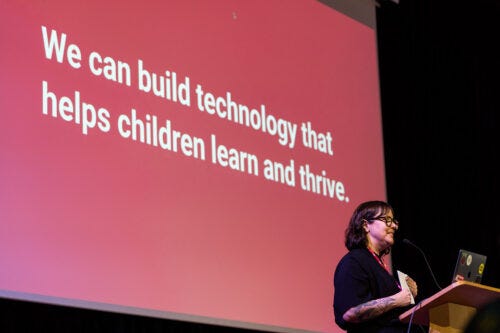
The Raspberry Pi Foundation’s draft principles
Laura and her team have brought together these existing ways of working with their research into what the leading thinking and evidence says and created eight principles, designed to practically guide the work of teams. These are still in draft, whilst they consult with others.
“Our principles are built upon the work on children’s digital rights. We’ve been looking at all of these frameworks and picking the bits that make sense to us, adapting them into something that is useful for making decisions in an organisation day-to-day,” says Laura.
Here are their draft principles:
The best interests of the child come first.
Our technology supports human relationships. It does not replace them.
We only collect the data we need.
We design for learning and prove its impact.
We design with children and educators, not for them.
We design for diverse needs, abilities and contexts.
We are transparent and accountable.
We apply the highest standards of children’s rights globally.
She says that being able to cite examples are really important to help teams understand how to apply the principles. “When we started sharing them around to all the different teams, the most common thing that came up was: but in this previous example, what would we have done differently?”
She says being able to work through some of these dilemmas has helped them think about how to put them into practice. “In discussing these trade-offs and examples with the teams, it has actually brought to life how we would actually use them.”
A call to action
“We’ve figured out our internal stance on these things,” says Laura. “Firstly, so that we can enter into the discussion publicly and say here’s what we think about these things but secondly so that we can put our hands on our heart and say that the products we’re developing for children are safe and ethical and responsible.”
She believes that this will help create the space for the necessary discussion: “If organisations like the Raspberry Pi Foundation can take a really strong stance on the ethical imperative around making technology we know is beneficial for children, that will influence the debate.”
She acknowledges that this is much easier for them to do as a large, endowment backed non-profit. But she hopes that their work will make it easier for others. “If we, as a nonprofit working with other nonprofits, start to socialise our principles and raise the standard, other commercial organisations will be incentivised to do the same.”
She believes that it requires collective action and would love to engage with others interested in taking a coordinated approach to rebuilding public confidence. “Trust in technology companies is decreasing. We have to earn people’s trust.”
You can read more about The Raspberry Pi Foundation’s principles on their blog. If you would like to be part of their coalition of like-minded organisations or have views on the draft principles they’ve shared, they would love to hear from you. Get in touch.
References
The principles draw heavily upon the following references. These are a good starting point if you want to explore further.
UNICEF’s ResponsibleInnovation in Technology for Children framework
Designing for Children’s Rights Association, design principles