


“We had hit a lot of metrics which indicated success. But at the same time, we were never satisfied we had found true product market fit,” remembers Jack Hylands, FourthRev’s cofounder and co-CEO. “There were lots of reasons why things were good. But the business wasn’t as scalable as we thought it needed to be.”
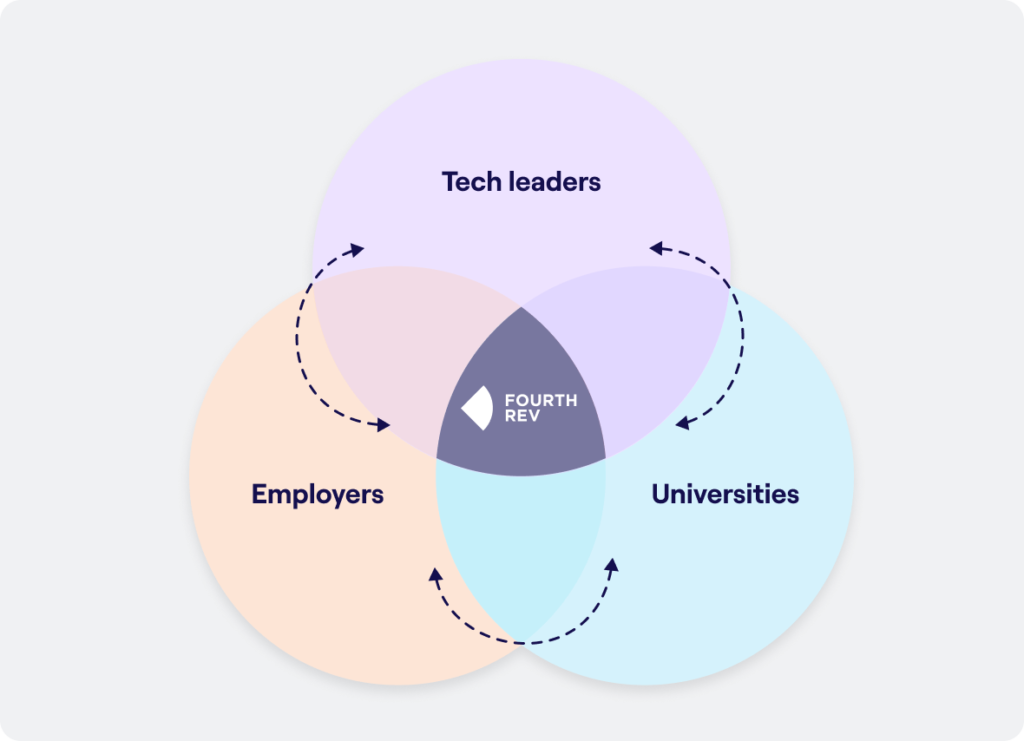
Jack is looking back to year two of FourthRev, when they had achieved significant traction. FourthRev bridges the gap between leading companies and universities to deliver industry recognised skills. By 2021 they had established a range of meaningful university partnerships in the UK and Australia, had thousands of students learning with them, seven figure revenue and VC investment. No mean feat.
But after some soul searching they recognised that while their course catalogue was a powerful proof-of-concept, scaling their impact would require a more integrated, end-to-end model.
Today, FourthRev runs a range of successful Career Accelerators with a small number of top university brands including the London School of Economics, Kings College London and the University of Cambridge in high-demand areas like Product Management, Data Science, Marketing, Product Design and AI Leadership.
So how did they build credibility and an attractive initial position in a notoriously difficult market and then strategically evolve the model to scale their impact and deliver stronger value to industry, universities, faculty and students in equal measure?
Jack talked me through the key milestones on their journey and the strategic lessons that might inform others building trusted partnerships in complex systems.
Beginnings
Jack started his career as a Maths teacher in South London as part of the Teach First programme.
“What I felt quite clearly whilst I was teaching was that getting students to university wasn’t the end point. That was just a stepping stone to the career and the life opportunities that they were seeking,” he remembers. “But in many instances, going to university wasn’t actually translating into the outcomes they aspired to.”
After a brief spell in management consultancy, he found his way into online education, partnering with universities to build online degrees and then leading online product at Melbourne’s RMIT, the biggest university in the APAC region.
“I’ve now spent the last 15 years focused on the problem I identified as a teacher: how do we bridge that gap between university and industry to meet the needs of modern learners?”
In 2019, he co-founded FourthRev with Omar de Silva, a serial entrepreneur who also had a background in education and shared his vision.
“The problem we saw was that universities wanted to partner with industry more. And there’s also plenty of examples of industry wanting to partner with universities. But there was a lot of friction and inefficiency in that relationship,” he explains. “Another key challenge was that content and curriculum, in high growth fields, is very fast moving. So we focused on bridging that gap by being the common link between universities and industry, and making that process a lot more efficient and scalable.”
Building on the relationships they had developed with leading tech companies like Salesforce, Tableau and Amazon Web Services, they began creating a catalogue of online courses teaching up-to-date industry relevant skills that met university standards.
“We knew that these skills were clear differentiators in the job market,” he says. “The vision was to embed them within existing degree programs to enhance the learner experience. Universities have thousands of students, and our goal was to make sure those students were as well equipped for the workforce as possible, as part of their broader university education.”
As well as becoming academically qualified, students would also be industry certified. “We believe that is a great proposition for students.”
To overcome the chicken and egg problem that building a marketplace entails, as well as building relationships with industry, they simultaneously nurtured relationships they had with universities.
“If a university partner wanted to move into the cloud engineering space, then we made sure that we also had a conversation going with AWS, which meant that we could move fast,” he explains.
“It allowed us to generate revenue quickly. It’s a great way to fund early product development and there are lots of benefits to working very closely with a customer early on. But it does risk turning into a service model, building solutions for a particular client. You have to remain disciplined to focus on building a scalable product.”
Despite its challenges, through taking this approach they built a sizeable course catalogue they could licence to other institutions: an online digital academy-in-a-box.
The pair had launched the business together in Melbourne. After six months, Jack moved back to the UK, which enabled them to nurture similar relationships with UK institutions. These partnerships, along with their growing catalogue of industry certified courses, enabled them to raise their first VC investment.
Building trust and credibility
So what does he think were the things that they did right during this period that others could learn from?
“There were some very small things that universities could bite off, which meant that decisions could be made more quickly,” reckons Jack. “They didn’t need to be raised all the way to the top of the university. If you start with big multi-year commitments there are many more hurdles to navigate.”
Through their deep understanding of universities, they also made sure to address anything that could be a potential blocker. For example universities could either host courses on their own Learning Management System or FourthRev could offer them a hosted instance of Canvas.
“We chose Canvas on the basis that it is the Learning Management System market leader. So that helped address any concerns around the core technology.”
They found immediate traction with universities that already had a strategy in place to build out solutions around digital skills and technologies. “We had a solution that was faster, cheaper and higher quality than doing it themselves.”
A challenge they discovered was that each institution brought unique strategic priorities, which required them to adapt the product for every university. “It was clearly valuable, but hard to scale efficiently,” he says.
The challenge with integration
The original industry certified course catalogue was built to be integrated into degree programmes. The challenge was that degree structures in the UK and Australia, tend to be tightly defined, which makes embedding new content hard without disrupting existing structures, including accreditation and commercial models.
“The US has a culture of majors and minors in liberal arts degrees. Students can go to another faculty and get credits for different courses,” explains Jack. “Whereas, in the UK, if you are studying history, then you are studying for three years within a very specific degree structure. There isn’t an easy option to carve out electives or the necessary flexibility to integrate industry skill courses.”
They also found the business model had challenges. “Even if the benefits were clearly appreciated, in the short term it could be seen as an additional cost not typically incurred when delivering that degree.”
Both of these issues were core challenges to scaling the initial vision of working within degree programmes.
But they were also getting clear signals of what might work. “Universities consistently valued our offer and sought deeper collaboration — particularly around new programme development aligned to emerging skill needs and career outcomes.”
Listening carefully to what their partners were valuing and asking for made it clear that instead of creating co-curricular, they needed to focus on new programmes for lifelong learners. This opened up a whole new range of questions.
They saw the opportunity to go beyond enhancing the student experience within existing structures. Instead co-create new programme models from the ground up. They also recognised that scaling these programmes would mean taking on additional responsibilities across the full learner journey: from supporting programme design through to enrolment, delivery and outcomes.
Evolving the model to launch Career Accelerators
Jack admits that leaning into these conclusions wasn’t straightforward. “The majority of startups don’t really get off the ground. And we had got to the point where we had multiple customers, thousands of students and we were generating seven figures of annual revenue. So there was obviously part of us that wanted to stay tightly focused on our existing solution.”
But they made sure to keep challenging themselves to be critical about how things were going and tried not to be distracted by short term, vanity metrics.
“We took a step back and asked ourselves, what are the critical pain points which are preventing us from scaling the business. How would we address those?”
They decided to look at every aspect of the value chain that would need to be working successfully in order for a new programme model to work. This included, promoting the programs, recruiting the learners, bringing in industry experts to support faculty delivery, and all making sure that they could actually deliver on career outcomes at the end of the program.
“When we took a step back, we thought, these are all things we’ve done before, just not in our current model,” remembers Jack. “We also knew that standing still would limit our mission and believed that scaling our impact required evolution. If you stand still, then you know it’s only going to end up at one point anyway.”
These observations helped steel them to confidently rearticulate their vision: “Career accelerators combine the very best of a great university education, with the very best of careers-focused, industry co-created programmes.”

A new partnership model
They realised that this new strategy also meant that they should work with fewer university partners, and have deeper relationships with prestigious universities to co-create offerings that would give learners the best possible chance in the job market. FourthRev would now be marketing courses directly to learners, “so it meant refining our model to focus on deeper partnerships with a smaller number of highly aligned university brands.”
They launched their first career accelerator with the London School of Economics, which was possible, he says, due to the credibility we had built over years working closely with academic teams and growing an impressive leadership team with track records in the sector.
“We weren’t just coming to the LSE with a slide deck and a vision. We had credibility from working in the sector for a number of years and this gave us the platform that we could launch this offer from,” he says.
“When we partnered with LSE, I was incredibly confident that it was going to work,” he recalls. “We knew we could deliver. We were doing it with the right partner, in the right space: our first program was data analytics.”
They then expanded to other fields — identifying high-growth skill areas and aligning with universities and academics best placed to deliver them.
“You need to find the faculty and the academics that want to embark on building a programme. You need all sides. So you’ve got a list of dream programmes that you want to build, and the ideal partners to do those with. Then you’ve got the reality of establishing those relationships.”
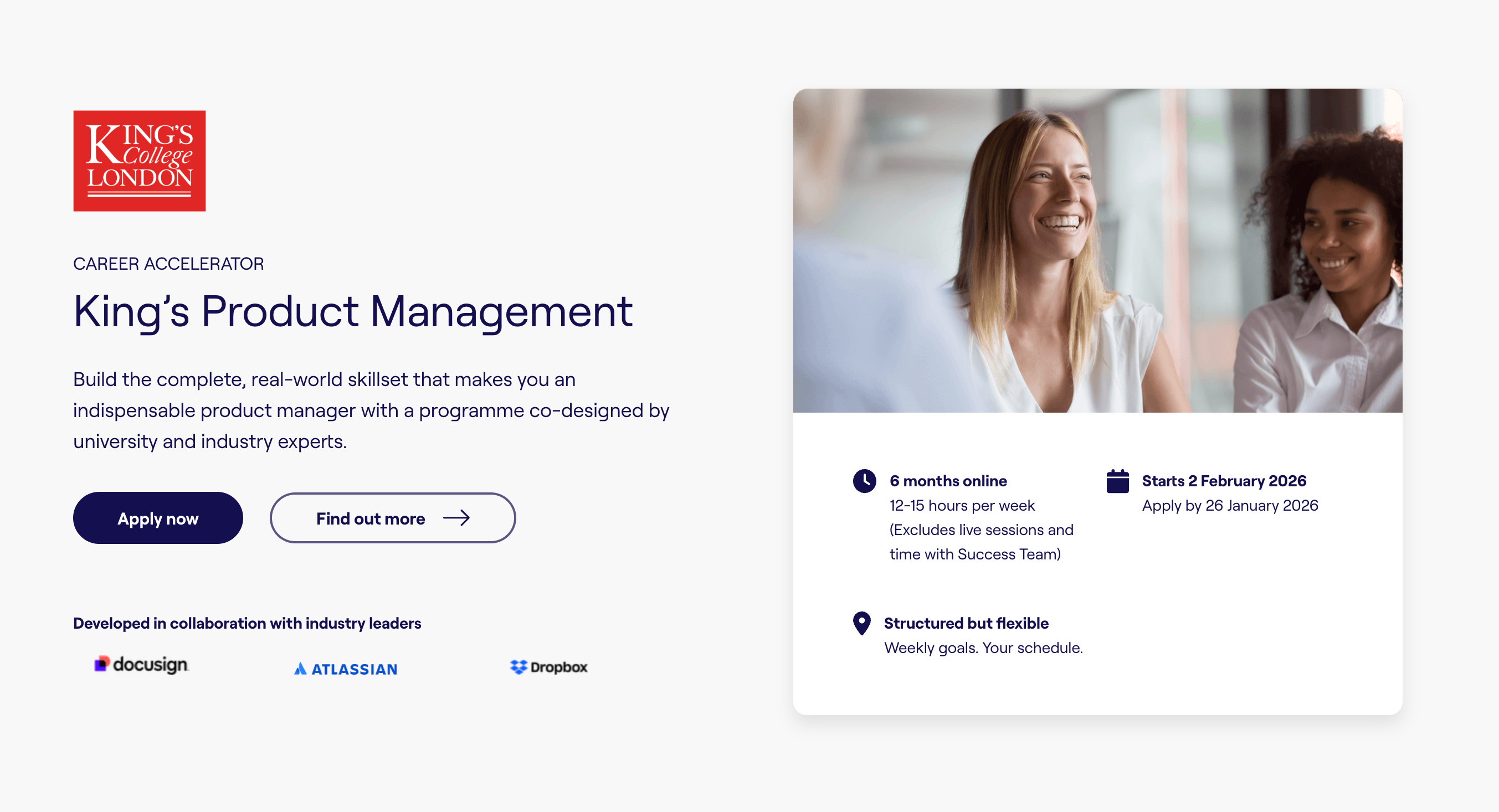
Soon after followed a Career accelerator in Product Management, co-designed with Kings College London.
Differentiating from Online Programme Managers
FourthRev’s model differs from the traditional Online Programme Manager (OPM) approach, which typically helps universities bring their existing degrees online.
Jack has experience with this model, and reflects on how FourthRev’s path evolved:
“Universities have made important progress in extending access to their degrees through online delivery and, for many institutions, this is a key strategic priority. The strongest brands have built differentiated offerings that scale while maintaining academic integrity.”
He continues: “At the same time, as more institutions move online, many face the challenge of standing out in an increasingly competitive landscape. With rising learner expectations and escalating acquisition costs, there’s growing pressure on digital programmes to demonstrate clear value, particularly around outcomes.”
Rather than seeing this as a problem to critique, FourthRev saw a different kind of opportunity.
“We weren’t focused on putting traditional courses online,” Jack explains. “We saw a way to work alongside universities to unlock a new kind of offer. One that leverages the university’s academic rigour and brand, but is built specifically for a different kind of learner: career-motivated professionals seeking applied skills, portfolio work and employer-aligned pathways. This is a major source of unmet need in the geographies we work in.”
Career Accelerators don’t replace or compete with online degrees. Instead, they extend the university’s reach to new markets and create a differentiated experience with its own pedagogy and purpose.
“They’re designed to serve learners that universities may not otherwise reach through their existing portfolio,” says Jack. “But critically, they still carry the university’s academic signature and they’re created with faculty. Our role is to bring in industry and outcomes alignment to create a new, collaborative model that reflects the best of both worlds.”
“We’re always learning from the institutions we partner with. Our approach is rooted in collaboration. We know that universities bring deep academic and pedagogical expertise, and our role is to complement that with industry alignment and learner outcome design.”
Getting to product-market fit
He says that ultimately, they achieved product-market fit by aligning their offer with the strategic goals of each stakeholder — learners, employers, faculty, and institutions alike
Universities: “We help them meet their strategic goals to serve a broader audience, and generate more revenue, working closer with industry and delivering great career outcomes.”
Faculty: “They are the key contributors. They ultimately own the course and we work with them in genuine collaboration, with faculty leading curriculum development and industry enriching it with applied relevance”
Employers: “Get access to a new pool of talent with the right skills.”
Learners: “A unique proposition: they gain a holistic, highly relevant skillset, a portfolio working with industry and certification from top universities they trust.”
He also reflects on the importance of what some people refer to as founder-market fit. He believes that this is particularly important in regulated environments like Higher Education.
“You do get examples of people coming in with completely fresh eyes and building transformational startups because you’re not yet held back by any of the existing ways of doing things,” he says. “But where there is more regulation, this can be a real challenge. There are fundamental things that you have to navigate and it’s easy to underestimate the complexities and risk credibility in the process.”
What’s next in a world being transformed by AI
He says that they’ve reached a point where they are confident in their system: “We are always striving to improve but we now have a repeatable system that allows us to identify the right programme opportunities, engage the right audiences, deliver an exceptional learner experience and ensure strong outcomes”, he says. “From a student experience and outcomes perspective, as well as commercially, we’re getting all of those things to work in a way that’s driving real value and growth.”
He thinks that there’s more to do with their existing programmes to reach wider audiences, both domestically and internationally. They are continuing to work with their existing partners to help them invest in the right opportunities. But there is also potential to work with new partners that “might have resonance with different audiences and markets.”
He also reflects on the fast moving market. “AI in particular, provides both headwinds and tailwinds,” he says. “AI means that people need to retrain. People in every role are having to ask, what different and new skills do I need? We’ve got great strengths in data and AI, and so there’s a huge opportunity for us to be a great part of the solution for individuals and the wider workforce to upskill and re-skill.”
But he’s also acutely aware that AI is changing educational models. “We offer a high touch experience - how do we augment that? What might fundamentally change and where do we need to be on the front foot in how we leverage AI to further enhance our experience and to enable all of the humans involved in delivering our experience?”
Lessons learned
We finish by reflecting on the lessons learned and evolving their initial solution.
“Early on, we really understood a lot about our customers and we could start working with them quickly, and generating revenue,” he says. “This also brought challenges, if you start working with customers from the very beginning you need to be very disciplined to ensure you are also building for greater scale”.
“But if you want to build strategic partnerships with very high caliber institutions, then you need to bring in a great deal of credibility. For us, having the foundation that we built early on was really important and has allowed us to build Career Accelerators in a really fantastic way that we wouldn’t have been able to do without those foundations.”
We summarise the key points:
Work hard to establish credibility first. FourthRev’s early traction with universities, and the team this enabled them to build, gave them the credibility for more ambitious proposals later.
Aim for founder-market fit. In regulated industries like higher education, it is easy to get stuck if you lack experience. Find the space you know how to navigate.
Listen carefully to what your partners want. Ultimately universities didn’t want skills courses they could integrate into degrees at scale - they wanted new career focussed programmes.
Be prepared to fundamentally rethink your model. Once FourthRev began launching new programmes, they knew that instead of partnerships with many universities, they needed deep relationships with a smaller number of the right brands.
Find a model that brings value to all sides. They found product-market fit once they could provide value to universities, faculty, employers and learners.
Be consistent about your vision. Maintaining a clear focus on career outcomes enabled them to adapt the solution but deliver on their mission.
It’s this final point that Jack says is about finding the pragmatic balance.
“Entrepreneurs need to be optimists. But you have to be realists,” he says. “It’s about having a growth mindset and getting into the real challenges that you’re facing, and then being optimistic about how you’re going to solve them. And it was about recognising what needed to change whilst remaining consistent to our North Star: how do we better connect universities and industry to drive career outcomes?”
FourthRev are currently hiring for a Head of Learner Experience & Delivery. If you have a huge passion for customer experience and significant experience leading delivery or programme teams in EdTech scale‑ups or a comparable environment or know someone who is, then get in touch.